Healthspan Map research · Updated November 27, 2026 · 595 clinics · no embargo
State of US longevity clinics 2026: prices, credentials and the evidence behind what 595 clinics sell
By the Healthspan Map research team · Published November 26, 2026 · Updated November 27, 2026
Longevity clinics promise more healthy years. What do they actually sell, who stands behind it, and what does it cost? We recorded the services advertised on the websites of 595 US clinics in 15 metro areas. For prices, named clinicians and transparency we use a full review of 196 of those clinics — the set whose websites we checked in detail in November 2026. The other 399 listings have services recorded but not yet a full price or team review, so they are not counted as hiding a price or as naming no clinician. We then graded each of the 17 services against published research.
The short version: the market mixes proven medicine with expensive add-ons that have little evidence behind them, often on the same menu. It is also hard for a patient to know who is in charge or what anything costs before walking in. How we did it · For journalists · Download the data
83%
sell at least one service with little or no human evidence for wellness use (495 of 595)
45%
of the 172 reviewed clinics that sell prescription-type therapies name no clinician at all
46%
of the 196 clinics we reviewed for clinicians name a physician (MD or DO)
33%
of the 196 clinics we reviewed for prices publish any price (64 of 196)
Seven findings
- Unproven add-ons are the norm. 495 of 595 clinics (83%) sell at least one service in our lowest evidence tier: NAD+ therapy, IV vitamin drips, wellness peptides or ozone. 171 (29%) sell three or more.
- Prescriptions, but no named prescriber. Of the 196 clinics we reviewed for clinicians, 172 sell GLP-1 drugs, testosterone, hormone therapy or peptides. 78 of those 172 (45%) do not name a single clinician on their website, and 79 (46%) name an MD or DO. (In the full directory, 546 of 595 clinics advertise at least one of these therapies.)
- Two in three of the clinics we reviewed hide their prices. Only 64 of those 196 (33%) publish any price. Together they list 116 prices. Every price figure in this study comes from those 64 clinics; each row and comparison shows its n. We have not yet recorded prices for the other 399 clinics in the directory.
- NAD+ is everywhere, and its price is all over the place. 222 clinics (37%) sell NAD+ therapy. Published prices run from $49 for a single shot to $850 for one premium infusion, with a median of $324 across 16 price points. No trial has shown a health benefit of IV NAD+.
- A typical membership costs about $274 a month. The 12 published monthly memberships (n=12 clinics with a monthly price) range from $75 to $799. At the top end, one program lists $125,000 a year.
- The best-evidenced tests are the rarest. Coronary calcium scoring (8%), DEXA (12%) and VO2 max testing (13%) are offered far less often than peptides (73%) or IV drips (50%).
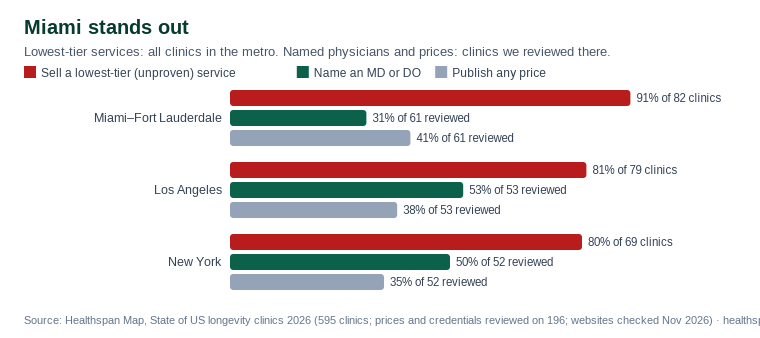
- Miami stands out. In the Miami–Fort Lauderdale area, 91% of 82 clinics sell a lowest-tier service, but only 31% of the 61 we reviewed there name an MD or DO. In Los Angeles that share is 53% of 53, and in New York it is 50% of 52. Those are the only metros with enough fully reviewed clinics for a credentials comparison.
What clinics sell, and how strong the evidence is
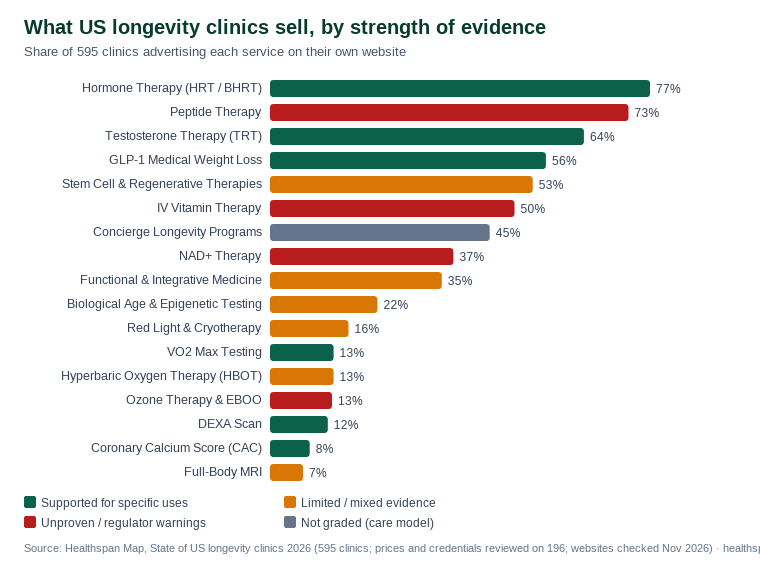
We graded each service as clinics usually market it, not every possible medical use. Supported: guidelines or large randomized trials support it for defined medical uses. Limited / mixed: some evidence, but limited, mixed or early for how it is sold. Unproven / regulator warnings: little or no human evidence for wellness use, or explicit FDA or federal warnings. When a category mixed treatments with different evidence, we chose the more favorable grade. This is an evidence summary, not medical advice.
| Service | Clinics | Tier | What the evidence says (primary sources) |
|---|---|---|---|
| Hormone Therapy (HRT / BHRT) | 460 (77%) | Supported (for specific uses) | FDA-approved menopausal hormone therapy is the most effective treatment for hot flashes and helps prevent bone loss, mainly for women under 60 or within 10 years of menopause. It is not recommended to prevent heart disease or dementia, and compounded 'bioidentical' hormones are not FDA-approved. Sources: The North American Menopause Society, 2022 position statement; FDA: menopause and hormones. |
| Peptide Therapy | 434 (73%) | Unproven / regulator warnings | Apart from a few FDA-approved peptide drugs, most 'wellness' peptides have little human evidence. In 2023 the FDA listed BPC-157 and other popular peptides among compounding substances that may present significant safety risks. In October 2026, HHS said it would not take enforcement action against small (503A) compounding pharmacies that make six of them, including BPC-157. That is an enforcement policy, not FDA approval, and it does not mean the peptides have been shown to be safe or effective. Sources: FDA: bulk drug substances that may present significant safety risks; HHS enforcement discretion policy, Federal Register, Oct 30, 2026. |
| Testosterone Therapy (TRT) | 380 (64%) | Supported (for specific uses) | Supported for men with confirmed testosterone deficiency (two low morning tests plus symptoms). The TRAVERSE trial found no increase in major cardiac events in that group. Benefits for 'age-related' low-normal levels are modest or unclear. Sources: Snyder et al., NEJM 2016 (Testosterone Trials); Lincoff et al., NEJM 2023 (TRAVERSE); AUA testosterone deficiency guideline. |
| GLP-1 Medical Weight Loss | 334 (56%) | Supported (for specific uses) | Large RCTs show average weight loss of about 15% (semaglutide, STEP-1) to about 20% (tirzepatide, SURMOUNT-1), and semaglutide cut major cardiovascular events by 20% in people with heart disease and overweight (SELECT). Caveat: the FDA has warned about unapproved and compounded versions. Sources: Wilding et al., NEJM 2021 (STEP-1); Jastreboff et al., NEJM 2022 (SURMOUNT-1); Lincoff et al., NEJM 2023 (SELECT); FDA: concerns with unapproved GLP-1 drugs. |
| Stem Cell & Regenerative Therapies | 318 (53%) | Limited / mixed | We graded this category conservatively because it mixes very different things. PRP (platelet-rich plasma) has mixed evidence that depends on the condition. Unapproved stem-cell and exosome products carry explicit FDA warnings, and three patients suffered severe vision loss in both eyes after 'stem cell' eye injections at a US clinic (NEJM 2017). The only FDA-approved stem-cell products are mainly cord-blood products for blood disorders. Sources: FDA: patient information on regenerative medicine therapies; Kuriyan et al., NEJM 2017; Turner & Knoepfler, Cell Stem Cell 2016. |
| IV Vitamin Therapy | 296 (50%) | Unproven / regulator warnings | IV fluids are proven in hospitals for dehydration. For healthy people, there are no good trials of vitamin drips for energy, immunity or aging. Even a placebo-controlled pilot of the Myers' cocktail in fibromyalgia found no significant difference from placebo. Sources: Ali et al., J Altern Complement Med 2009 (Myers' cocktail RCT). |
| Concierge Longevity Programs | 266 (45%) | Not graded | This is a membership care model, not a treatment. Its value depends on what is included (for example, evidence-based screening, blood pressure, lipids, fitness and sleep) and on the clinicians. Sources: USPSTF A and B recommendations. |
| NAD+ Therapy | 222 (37%) | Unproven / regulator warnings | The only published human pharmacokinetic study of IV NAD+ was a pilot that measured blood levels, not health outcomes. A 2026 meta-analysis of 15 RCTs of oral NMN (an NAD+ precursor) found it well tolerated, but found no clear metabolic benefit. Sources: Grant et al., Front Aging Neurosci 2019 (IV NAD+ pilot); Yang et al., Nutrients 2026 (NMN meta-analysis). |
| Functional & Integrative Medicine | 208 (35%) | Limited / mixed | There is no single defined intervention. One retrospective Cleveland Clinic cohort found a small quality-of-life gain at 6 months that was no longer significant at 12 months, and many specialty functional tests are not validated. Sources: Beidelschies et al., JAMA Netw Open 2019; NCCIH: what's in a name. |
| Biological Age & Epigenetic Testing | 130 (22%) | Limited / mixed | Epigenetic clocks such as DunedinPACE predict outcomes across populations, but individual results can vary between tests and repeat samples. No trial shows that lowering a clock score improves health. Sources: Belsky et al., eLife 2022 (DunedinPACE); Higgins-Chen et al., Nature Aging 2022 (clock reliability). |
| Red Light & Cryotherapy | 95 (16%) | Limited / mixed | Red light has some evidence for specific skin and pain uses. A Cochrane review rated all evidence on whole-body cryotherapy for recovery as 'very low' quality, and the FDA has not cleared any whole-body cryotherapy device. Sources: Costello et al., Cochrane 2015 (whole-body cryotherapy). |
| VO2 Max Testing | 77 (13%) | Supported (for specific uses) | A validated measurement. In large cohorts, cardiorespiratory fitness is one of the strongest predictors of all-cause mortality. The test measures fitness; it is not a treatment. Sources: Kodama et al., JAMA 2009 (meta-analysis); Mandsager et al., JAMA Netw Open 2018 (122,007 patients). |
| Hyperbaric Oxygen Therapy (HBOT) | 77 (13%) | Limited / mixed | Established for UHMS-recognized indications such as decompression sickness and carbon monoxide poisoning. A Cochrane review found short-term benefit for diabetic foot ulcers, but not at one year. The best-known anti-aging study was a single-arm study of 35 adults with no control group, run by a company that sells HBOT. Sources: UHMS: indications for HBOT; Kranke et al., Cochrane 2015; Hachmo et al., Aging 2020. |
| Ozone Therapy & EBOO | 75 (13%) | Unproven / regulator warnings | US federal rules state that ozone is a toxic gas with no known useful medical application in specific, adjunctive or preventive therapy. Sources: 21 CFR 801.415. |
| DEXA Scan | 70 (12%) | Supported (for specific uses) | DEXA is the standard test for osteoporosis, and the USPSTF recommends bone-density screening for women 65+ and younger postmenopausal women at higher risk. Body-composition DEXA is a precise measurement, though no trials show that tracking it improves outcomes. Sources: USPSTF, JAMA 2025: screening for osteoporosis. |
| Coronary Calcium Score (CAC) | 48 (8%) | Supported (for specific uses) | US prevention guidelines say a coronary artery calcium score is reasonable for adults at intermediate risk when deciding on statins. Sources: Arnett et al., 2019 ACC/AHA primary prevention guideline (Circulation). |
| Full-Body MRI | 40 (7%) | Limited / mixed | No major US medical society recommends whole-body MRI screening for average-risk adults. A 2026 meta-analysis of 9,024 asymptomatic people found confirmed cancer in 1.57%, and an earlier review found critical or indeterminate incidental findings in about 32%. There are no long-term outcome or cost-effectiveness data. Sources: Martins da Fonseca et al., Eur Radiol 2026 (meta-analysis); Kwee & Kwee, J Magn Reson Imaging 2019 (systematic review); American College of Radiology statement on total-body MRI screening (2023). |
What treatments cost
These figures use only the 64 clinics (of the 196 we reviewed for prices) that publish at least one price: 116 listed prices, or 102 once identical prices repeated across one chain's locations are counted once. We have not yet recorded prices for the other 399 clinics in the directory, so they are not in this table and are not treated as having no price. Each figure is the lowest or "from" price the clinic lists, and products and doses differ. n is the number of price points in that row. Small samples are labeled; treat them as indicative. Every price, with its source link, is in published-prices.csv.
| Service | Unit | Price points | Lowest | Median | Highest |
|---|---|---|---|---|---|
| NAD+ Therapy | per session / item | 16 | $49 | $324 | $850 |
| Concierge Longevity Programs | per month | 12 | $75 | $274 | $799 |
| Hormone Therapy (HRT / BHRT) | per month | 9 | $99 | $199 | $499 |
| Hyperbaric Oxygen Therapy (HBOT) | per session / item | 8 | $59 | $152.50 | $300 |
| IV Vitamin Therapy | per session / item | 7 | $145 | $200 | $599.95 |
| Peptide Therapy | per session / item | 7 | $99 | $350 | $555 |
| GLP-1 Medical Weight Loss | per month | 5 | $89 | $199 | $299 |
| Red Light & Cryotherapy | per session / item | 5 | $30 | $65 | $85 |
| Hormone Therapy (HRT / BHRT) | per session / item | 5 | $165 | $350 | $750 |
| Peptide Therapy | per month | 5 | $199 | $399 | $525 |
| DEXA Scan | per session / item | 3 (small sample) | $175 | $179 | $250 |
| GLP-1 Medical Weight Loss | per session / item | 3 (small sample) | $275 | $495 | $800 |
Only 2 price points: VO2 Max Testing $250 and $300 per session / item; Ozone Therapy & EBOO $165 and $200 per session / item; Concierge Longevity Programs $5,000 and $125,000 per year; Concierge Longevity Programs $470 and $1,595 per session / item; IV Vitamin Therapy $149 and $400 per month; Testosterone Therapy (TRT) $169 and $199 per month.
Full-body MRI: 40 clinics offer it, but only one provider publishes a price (n=1: $2,499 for a whole-body scan, listed at two locations).
Prices by city
Among those 64 clinics with a published price, median, range and number of price points for services with at least 2 price points in at least two of Miami, Los Angeles and New York. City samples are small, so read these as a snapshot, not an average. n is the number of price points. The full table is in prices-by-metro.csv.
| Service | Miami | Los Angeles | New York |
|---|---|---|---|
| Concierge Longevity Programs (per month) | $599 ($75–$799, n=5) | $100 ($99–$150, n=3) | $249 ($245–$549, n=3) |
| GLP-1 Medical Weight Loss (per month) | $149 ($89–$199, n=3) | – | $249 ($200–$299, n=2) |
| Hormone Therapy (HRT / BHRT) (per month) | $175 ($132–$249, n=4) | $339 ($179–$499, n=2) | $395 ($99–$399, n=3) |
| Hormone Therapy (HRT / BHRT) (per session / item) | – | $208 ($165–$250, n=2) | $625 ($500–$750, n=2) |
| Hyperbaric Oxygen Therapy (HBOT) (per session / item) | $155 ($59–$199, n=3) | – | $200 ($120–$300, n=4) |
| IV Vitamin Therapy (per session / item) | $372 ($145–$600, n=2) | $200 ($175–$220, n=3) | $218 ($190–$245, n=2) |
| NAD+ Therapy (per session / item) | $239 ($49–$299, n=4) | $382 ($159–$499, n=4) | $349 ($75–$850, n=8) |
| Peptide Therapy (per month) | – | $324 ($199–$449, n=2) | $349 ($199–$525, n=4) |
| Peptide Therapy (per session / item) | $375 ($99–$555, n=3) | $250 ($150–$350, n=2) | $238 ($100–$375, n=2) |
| Red Light & Cryotherapy (per session / item) | $55 ($30–$79, n=2) | – | $58 ($50–$65, n=2) |
Membership prices
43 of the 196 clinics we reviewed describe a membership or program, but only 12 publish a monthly price. Each dot is one clinic's lowest published monthly tier (n=12).
Annual programs: $5,000 and $125,000 a year. Some memberships also require a minimum commitment of 3 to 6 months.
What $2,499 buys you
$2,499 is the one published whole-body MRI price in our data (n=1). At median published prices, the same money buys (n on each card):
- 13 DEXA scans
median $179, n=3 - 7 NAD+ sessions
median $324, n=16 - 16 hyperbaric oxygen sessions
median $152.50, n=8 - 9 months of a typical longevity membership
median $274/month, n=12 - 12 IV vitamin drips
median $200, n=7
Who is behind the care
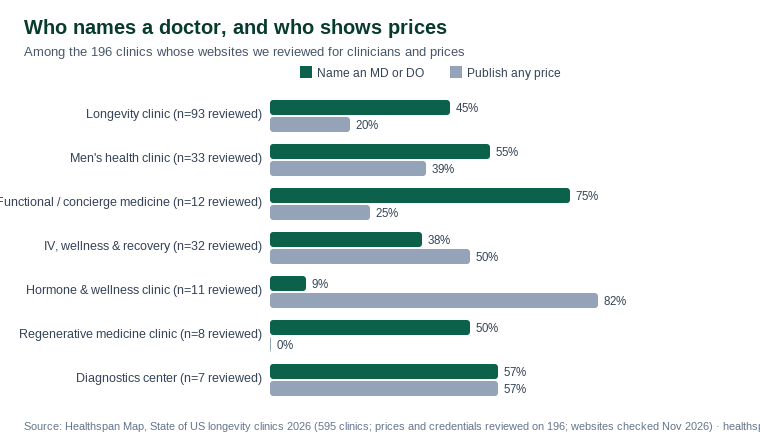
"Names a prescriber" means an MD, DO, nurse practitioner or physician assistant. The transparency score (0–20) measures only what a clinic publishes about itself, not the quality of care. It gives up to 8 points for prices, 4 for naming a physician, 2 for listing clinical staff and 2 for an NPI Registry match, plus 1 each for first-visit details, hours, programs and payment terms. Among the 196 clinics we reviewed, the median score is 7, and 70 (36%) score 3 or less.
| Clinic type | In directory | Reviewed | Name an MD/DO | Name any prescriber | Name no clinician | Publish a price | Mean score |
|---|---|---|---|---|---|---|---|
| Longevity clinic | 235 | 93 | 45% | 48% | 51% | 20% | 5.2 |
| Men's health clinic | 189 | 33 | 55% | 61% | 39% | 39% | 6.8 |
| Functional / concierge medicine | 73 | 12 | 75% | 83% | 17% | 25% | 8.9 |
| IV, wellness & recovery | 36 | 32 | 38% | 50% | 47% | 50% | 7.5 |
| Hormone & wellness clinic | 29 | 11 | 9% | 9% | 64% | 82% | 6 |
| Regenerative medicine clinic | 26 | 8 | 50% | 50% | 50% | 0% | 5.2 |
| Diagnostics center | 7 | 7 | 57% | 57% | 43% | 57% | 7.4 |
| All clinics | 595 | 196 | 46% | 51% | 46% | 33% | 6.2 |
Credential, published-price and transparency figures are among the 196 clinics we reviewed, not the 399 later listings. Groups with fewer than 15 reviewed clinics are small, so differences between them are indicative only.
Where the clinics are
| Metro | Clinics | Sell a lowest-tier service | Name an MD/DO | Name no clinician | Publish a price |
|---|---|---|---|---|---|
| Miami–Fort Lauderdale | 82 | 91% | 31% | 51% | 41% |
| Los Angeles | 79 | 81% | 53% | 45% | 38% |
| New York | 69 | 80% | 50% | 44% | 35% |
| Dallas–Fort Worth | 39 | 85% | — | — | — |
| Denver–Boulder | 38 | 84% | — | — | — |
| Houston | 35 | 77% | — | — | — |
| Phoenix–Scottsdale | 35 | 89% | — | — | — |
| San Francisco Bay Area | 32 | 72% | — | — | — |
| San Diego | 30 | 87% | — | — | — |
| Atlanta | 29 | 86% | — | — | — |
| Austin | 27 | 78% | — | — | — |
| Boston | 27 | 89% | — | — | — |
| Chicago | 25 | 68% | — | — | — |
| Nashville | 25 | 88% | — | — | — |
| Seattle | 23 | 87% | — | — | — |
Shares that sell a lowest-tier service use every clinic in the metro. Named-physician and published-price shares use only the clinics we reviewed there, and only where that review set has at least 15 clinics (Miami 61, Los Angeles 53, New York 52). Other metros have too few fully reviewed clinics for a share.
Why there is no "clinics per capita" figure: this is a large sample, not a census of every clinic in each metro, so coverage may still vary. A count per resident would reflect that, not the real market. We compare shares within each metro instead.
More angles from the data
- Proven and unproven on the same menu. 460 clinics (77%) sell both a guideline-supported service (such as GLP-1 drugs, hormone therapy or DEXA) and a lowest-tier one.
- Peptides after the HHS policy change. 434 clinics advertise peptides. Of the 128 we reviewed for clinicians, 61 (48%) name no clinician. In October 2026, HHS said it would not penalize small compounding pharmacies that make six popular peptides. That is an enforcement policy, not FDA approval.
- Full-body MRI is sold with little information. 40 clinics advertise full-body MRI. Of the 25 we reviewed for clinicians, 17 name no clinician on their site. Only one provider publishes a price for the scan (n=1).
- The "everything" clinic. 55 clinics advertise 10 or more of the 17 services we track, and one advertises 14.
- Mostly cash. Of the 196 clinics we reviewed, only 15 (8%) say on their website that they accept insurance. 11 mention HSA or FSA payments. We have not recorded payment terms for the later listings.
- Telehealth is common. 77 of the 196 clinics we reviewed (39%) mention telehealth or virtual visits.
For journalists
There is no embargo, and all figures and charts are free to use under CC BY 4.0 with a link to this page. We can pull a clinic-level breakdown for any metro in the study, or check a specific claim, usually within one business day.
Quotable lines
- “83% of the 595 US longevity clinics we checked sell at least one service with little or no human evidence for wellness use, such as NAD+ infusions, IV vitamin drips or wellness peptides.”
- “Of the 172 clinics we reviewed that sell prescription-type therapies like GLP-1 drugs, testosterone, hormones or peptides, 45% do not name a single clinician on their website.”
- “The tests with the strongest evidence are the hardest to find: 8% of clinics offer a coronary calcium score, while 73% sell peptides.”
- “Of the clinics we reviewed for prices, only 33% publish any price. Where they do, one NAD+ session ranges from $49 to $850 (n=16).”
How to cite
Healthspan Map, "State of US longevity clinics 2026" (595 clinics; prices and credentials reviewed on 196; data checked Nov 2026), https://healthspanmap.com/research/longevity-clinics-2026/
Short form: "according to a Healthspan Map analysis of 595 US longevity clinic websites (November 2026); prices and credentials reviewed on a subset of 196".
Embed a chart
Copy the HTML below. The charts are static SVG files: fast, sharp at any size and accessible.
Chart 1: chart-services-evidence.svg
Chart 2: chart-credentials-by-type.svg
Chart 3: chart-metros.svg
Contact
Press and data questions: [email protected]
Methodology
- Sample. Candidate businesses came from map and web searches for longevity, anti-aging, hormone, IV, regenerative and diagnostics clinics in 15 US metro areas. The directory now includes 595 clinics with a working website, a US address and at least one of the 17 services below. This is a large sample, not a census. Advertised services were recorded for all 595. Prices, named clinicians, hours, payment terms and transparency scores come from a full website review of 196 clinics, mostly in Miami, Los Angeles and New York, plus a smaller number in the other 12 metros. The other 399 listings were added on November 26, 2026 with services recorded but without a full price or team review; they are not treated as publishing no price or as naming no clinician.
- Services. We count a service only if the clinic's own website advertises it, and we keep the source URL for each service on each clinic profile. Clinics sell 5.9 of the 17 services on average.
- Prices. Every price median, range and comparison in this study uses only the 64 clinics (of the 196 reviewed) that publish at least one price, and each figure shows its n. We have not yet recorded prices for the other 399 clinics. Candidate prices were collected automatically from clinic websites, then reviewed individually against the page they came from. Monthly, annual and one-time prices are kept separate. Identical prices repeated across one chain's locations are counted once in medians.
- Credentials. Figures about named clinicians, NPIs and transparency use only the 196 clinics we reviewed for those fields. Clinician names and credentials come from the clinic's website. "Names a physician" means at least one MD or DO is named. We searched the CMS NPI Registry for each named clinician and record a match only when exactly one record fits. An NPI shows that a provider is registered; it is not a license check.
- Evidence tiers. Graded by the Healthspan Map research team from systematic reviews, randomized trials, US clinical guidelines and FDA or federal statements, all linked above. We checked each PubMed citation against its PubMed record.
- Dates. This edition was updated on November 27, 2026 to include advertised services from all 595 clinics in the directory. Websites in the 196-clinic review set were checked in Nov 2026. Clinics change their sites often, so each figure describes what was published at that time.
- Independence. Healthspan Map is an independent directory published by Percebe Research LLC. Clinics can buy an optional, clearly labeled featured listing. No clinic paid to be included or to influence this study, and none of the 595 clinics had a featured listing when the data were collected. See the directory methodology and advertising disclosure.
- Limitations. A website is not a full picture of a clinic. Clinicians may exist without being named, prices may be given by phone, and services may be described loosely. We report what a patient can see before booking.
Download the data (CSV)
- services-and-evidence.csv: clinics offering each service (of 595), with its evidence tier; named-physician and published-price counts are among the reviewed subset only
- prices-by-service.csv: price points (n) and the lowest, median and highest price by service and unit, from the 64 clinics that publish a price
- prices-by-metro.csv: the same for Miami, Los Angeles and New York
- published-prices.csv: every published price, with clinic, source URL and date checked
- transparency-by-clinic-type.csv: directory count and, among reviewed clinics, credentials and transparency by clinic type
- by-metro.csv: directory count and lowest-tier services for every metro; credentials and prices among reviewed clinics
Not medical advice. This study describes what clinics publish and what published research says about each category of service. It does not evaluate any individual clinic's care or outcomes. Talk to a licensed clinician about your own health.